The future of Africa’s industrialisation may not lie in silicon chips or machine learning but in sustainable natural materials and regional cooperation.
Across East and West Africa, governments are moving beyond extractive models and towards policies that fuse environmental resilience with industrial renewal. In Ghana, a national policy blueprint is steering the country’s economy towards non-plastic alternatives and substitutes as a new source of industrial growth. In the East African Community (EAC), a draft Single-Use Plastics (SUPs) Bill proposes a regionally binding roadmap to eliminate regulatory fragmentation in phasing out harmful SUPs and to build a foundation for a circular and regenerative economy.
Through the UK-UNCTAD Sustainable Manufacturing and Environmental Pollution (SMEP) Programme, short-term bans and clean-ups are being replaced by governments taking on the harder task of redesigning laws, markets and supply chains for inclusive new jobs, formalised waste economies, and a competitive foothold in the fast-emerging global circular bioeconomy.
Ghana pivots away from plastics
In Accra, over 40 senior policymakers have signed off on a five-year implementation plan for Ghana’s Plastic Alternatives and Non-plastic Substitutes Blueprint – the first of its kind in West Africa. Developed under the SMEP project, FRESHPPACT, the plan aligns economic incentives, public procurement, and clear key performance indicators (KPIs) with broader industrial strategy.
Pilots are underway targeting plastic mulch film, sachet water packaging and carrier bags – three of the country’s most visible, waste-heavy sectors.
The blueprint links to forthcoming Extended Producer Responsibility (EPR) rules and aims to harness regional trade in bio-based materials under the $3.4 trillion potential of African Continental Free Trade Area (AfCFTA).
A new and green industrial proposition
The EAC’s draft SUP Bill seeks to harmonise restriction and regulation of SUPs, closing cross-border loopholes that weaken national bans. Mr. Korir Sing’Oei, Kenya’s Principal Secretary for Foreign and Diaspora Affairs, notes: “Plastic controls must be paired with business-enabling measures, supportive policy frameworks, sustainable finance, and skills development.”
Beyond prohibition, it mandates EPR schemes, promotes investment in sustainable material manufacturing through targeted incentives and embeds provisions for a just transition with labour protections for informal waste workers, laying the legal and economic foundation for a regional circular economy.
As global negotiations for a plastics treaty advance, Africa is not waiting to adapt. Instead, it is designing ahead. With abundant agricultural biomass, mounting waste pressures and a young work force, the continent is uniquely placed to turn constraints into competitive advantage through low-emissions, circular strategies.
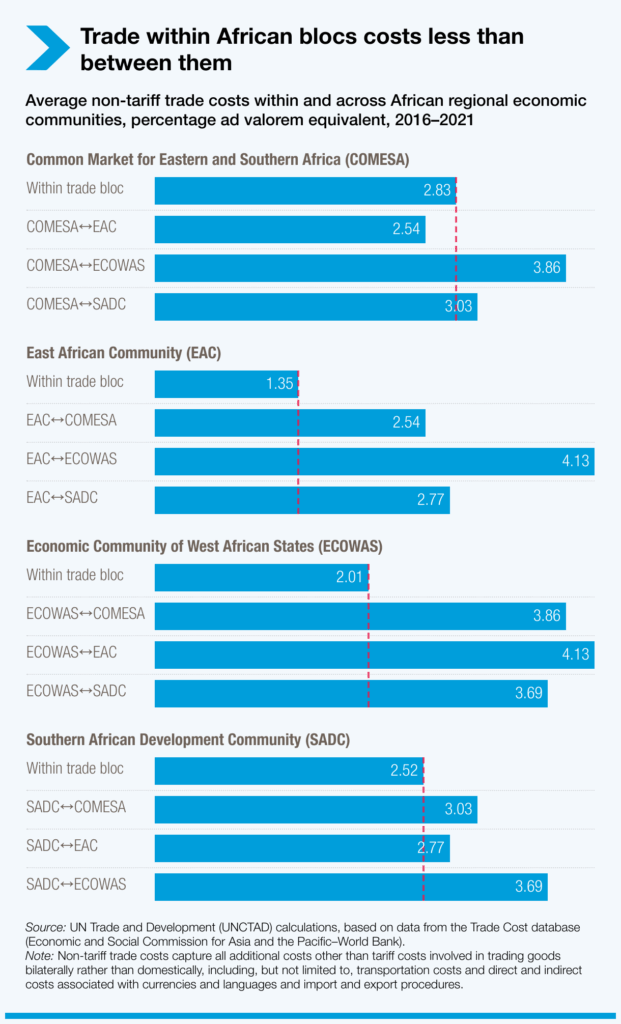
However, without strategic regional integration, their impact risks being contained, as shown in the figure on the right (an excerpt from UNCTAD’s Economic Development in Africa Report, 2024).
Realising Africa’s green industrial promise means tackling trade frictions, currency volatility and weak financial systems that hold small, medium enterprises (SMEs) back. UNCTAD is working with governments to reduce these costs and build stronger regional value chains. Its 16th Ministerial calls for stronger South–South trade and investment as a pathway to shared prosperity.
This Africa Industrialisation Day, one message stands out: the continent’s raw potential is being recast – beyond plastics, and on its own terms
Maria Durleva
UNCTAD-SMEP Programme Management Officer